|
5
Yucatan
 In the 1960s he had a rained-on semi-outdoor studio in Merida. He was heading for the acclaimed renderings he did ten years later. He worked on 50 or more watercolors at the same time, starting from quasi-aleatory blobs or fragmentary shapes, then cutting out what he liked, combining, pasting, erasing, re-painting. Evolving a vocabulary.
It was watercolor, but not the watery kind. He deliberately substituted his own creative imagination for the freshness of watercolor. He subdued the material.
There was some of the happy accident that makes watercolor popular among amateurs, but he was deliberate in selecting out the unexpected, so that he was being fashioned by his work as well as the converse.
|
6
This was a time of focus on shape, distinctive shape. Shape and line.
In my eulogy I said, “…it is possible to spot a Don Reich picture because of his distinctive line and how that line creates the compelling inner logic of the picture.
“His line was swift and deft. A long, shapely, sinuous, sensuous line. An intelligent and purposeful line, all thought out in advance.
“Like the Persian miniaturists, he could draw a completely convincing horse in one continuous line starting and ending at the point of a hoof.
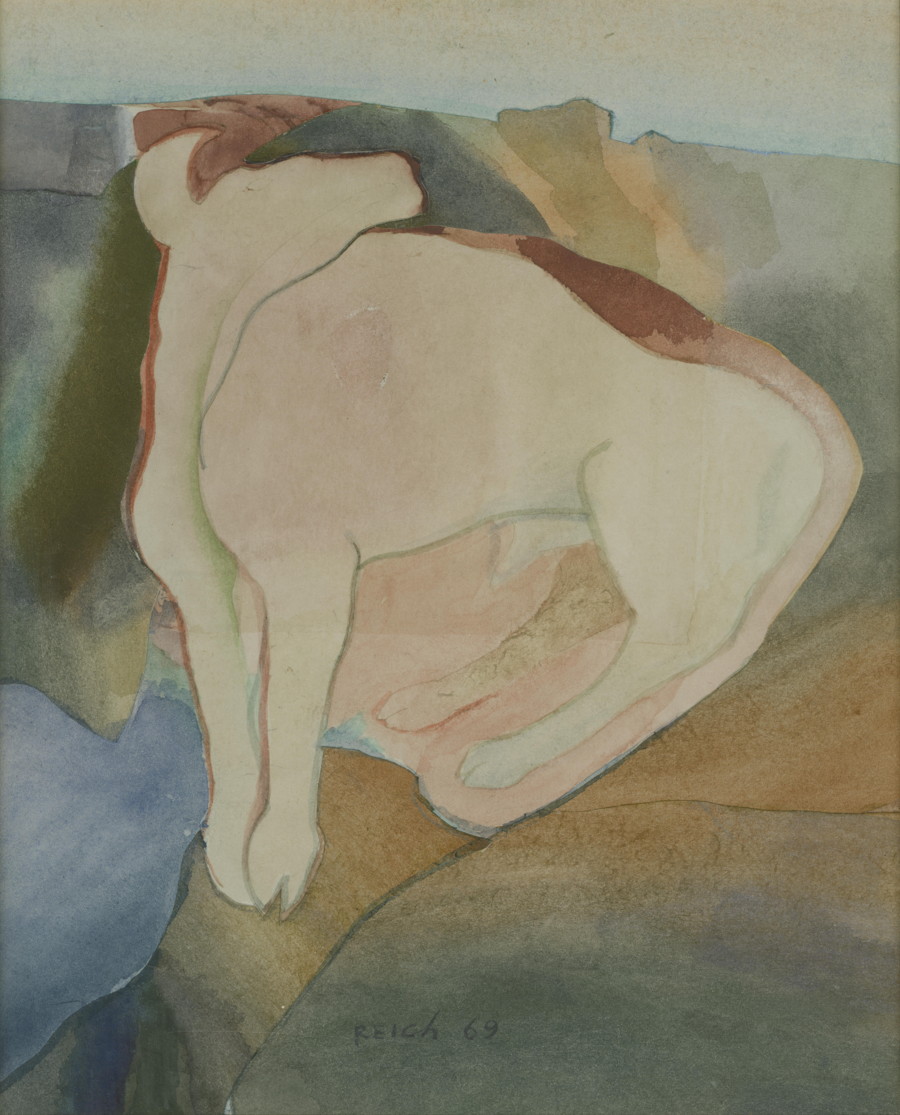
Brave Bull, 1969
|

