
| BACK | | NEXT |
|
15  Thomas Albright, reviewing the Legion show, said, “I like Reich’s work best when his major preoccupation is with pure technical
execution which (in this case) includes a heat-haze sense of filtered white light,
a connoisseur’s sense of tasteful color harmonies, a dynamic, dead twig pen line, and the fanciful use of such materials as wallpaper
and want ads that can stamp a seal of the State of Oregon into a white sky and entitle it ‘When the Sun Comes Out It Stays.’
“Perhaps the most successful work in the exhibition is a still life, ‘The Artist’s Studio,’ which in its restrained blend
of rich color and deftness of draftsmanship, reminds one of the studio paintings that Braque was doing in the Thirties.”
Thomas Albright, reviewing the Legion show, said, “I like Reich’s work best when his major preoccupation is with pure technical
execution which (in this case) includes a heat-haze sense of filtered white light,
a connoisseur’s sense of tasteful color harmonies, a dynamic, dead twig pen line, and the fanciful use of such materials as wallpaper
and want ads that can stamp a seal of the State of Oregon into a white sky and entitle it ‘When the Sun Comes Out It Stays.’
“Perhaps the most successful work in the exhibition is a still life, ‘The Artist’s Studio,’ which in its restrained blend
of rich color and deftness of draftsmanship, reminds one of the studio paintings that Braque was doing in the Thirties.”
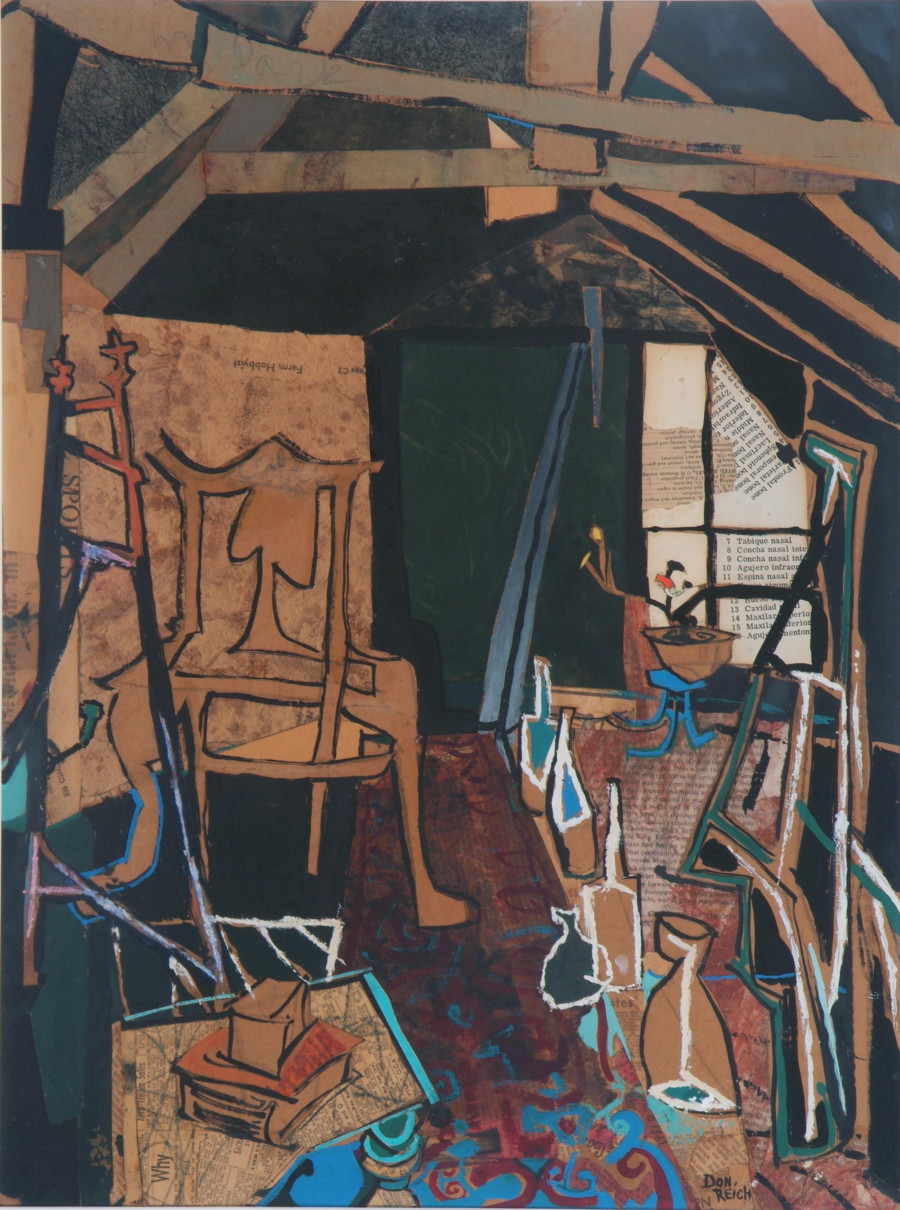
The Artist’s Studio circa 1960. |
16
Reich’s painting in the 1962 Winter Invitational at the Legion “distills in form and color the essence of a river levee,”
John Oglesby wrote in the Sacramento Bee. Another show prompted Oglesby to say that Reich’s semi-abstract landscapes “give the
impression …of him being the only artist who ever goes outdoors. Reich paints nature metamorphosed.”
Reich wrote a statement for one of his earlier shows:
“I work in collage because it pleases me. I use the colors I’ve set down because I can ‘taste’ them, and I use the objects seen here because I ‘am’ each one.
“In the years that remain, I will continue with the tasting of color and with the painting of things I have been, or am being. But my method of presenting
these things to others will always change.”
I don’t know if the high horizon was his idea originally. Others were doing them. The idea was to break into convention like an eldritch burglar,
leaving behind recognizable but disconcerting relationships between the viewer and the familiar.
Degas said the artist must approach his work in the spirit of the criminal about to commit a crime.
By raising the horizon, Reich threw the foreground forward and up into the viewer’s face and space. It was effective without feeling contrived or mechanical.
|
| BACK |  | NEXT |