
| BACK |
| NEXT |
|
57  “He shocks our image-saturated minds into a new awareness of the distinction between reality and the false realism of photography and photo-derived art, while at the same time defending and exploiting the power of illusion.”
Reviewer Marlan Miller found the renderings both delightful and macabre, and remarked their “tangibility.”
Eric Hellman, writing in Art Week about a show in San Francisco in 1979, said,
“Reich presents complex, fragmented images that are difficult to process…he questions established perceptions of the way things are.”
“…Reich contrasts an illusionary ideal with realistically crafted fantasy.”
Ten years before the renderings, Alexander Fried of the San Francisco Chronicle disliked the collages Reich showed at the Legion of Honor in the 60s because they were too simply descriptive and lacked "the true collagist’s curious crosscurrent of visual and emotional contradictions."
Ten years later, Reich intensified and exploded the cross currents with his renderings. It was the closest Reich came to explicit assertion. What would Fried have said to that? “He shocks our image-saturated minds into a new awareness of the distinction between reality and the false realism of photography and photo-derived art, while at the same time defending and exploiting the power of illusion.”
Reviewer Marlan Miller found the renderings both delightful and macabre, and remarked their “tangibility.”
Eric Hellman, writing in Art Week about a show in San Francisco in 1979, said,
“Reich presents complex, fragmented images that are difficult to process…he questions established perceptions of the way things are.”
“…Reich contrasts an illusionary ideal with realistically crafted fantasy.”
Ten years before the renderings, Alexander Fried of the San Francisco Chronicle disliked the collages Reich showed at the Legion of Honor in the 60s because they were too simply descriptive and lacked "the true collagist’s curious crosscurrent of visual and emotional contradictions."
Ten years later, Reich intensified and exploded the cross currents with his renderings. It was the closest Reich came to explicit assertion. What would Fried have said to that?
|
58 This work embodies Hegel’s view that art is “the sensuous presentation of ideas.”
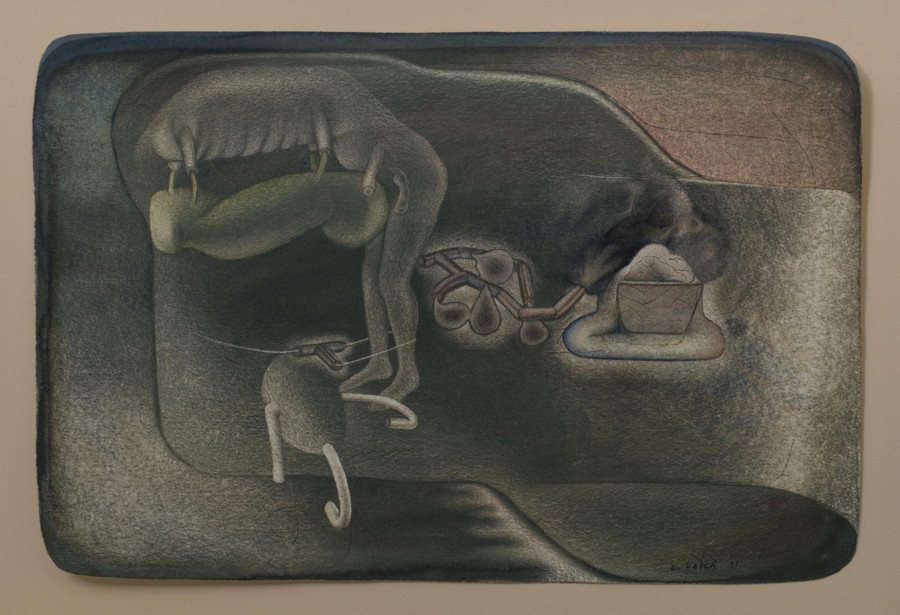
Untitled, 1971 Scraping. Candy Store By the 1960s, Reich had become a charter member of the stable of painters and ceramic sculptors at Adeliza McHugh’s Candy Store Gallery in Folsom, California, which included Bob Arneson, Roy De Forest, Jim Nutt, Gladys Nilsson and David Gilhooly.
Their work, although richly varied, was lumped together and called Funk Art as though it were a collective movement. Based mainly in Davis, it was a rough but childlike art that could be seen as a reaction against refined Bay Area Figurative which itself was seen as a reaction against East Coast Abstract Expressionism.
Hot versus cool versus hot.
|
| BACK | 
| NEXT |