
| BACK |
| NEXT |
|
47  These image images were then arranged and thoughtfully juxtaposed, on a lush watercolor wash on heavy paper. The contrast between the hard images and the luxurious ground was striking, theatrical. Intellect collides with sensuality. Like the watercolor fragments in Yucatan. The arrangements were often disruptive or humorous or surprising or pornish, the juxtapositions and joinings creating a syntax of aggressive rebus-like quotations without context. Realism inverted and subverted.
The works could be seen as fantasy, mere fantasy, but it was fantasy not as an escape from reality, but a way of dealing with it, vanquishing it.
There was a kind of progression: the drawn line of his early work, to the cut lines of the collages, to the drawn cut lines of the renderings. But nevertheless drawn, by him.
In a group show at American River College, I termed him the “hot” opposite of “cool” artists like Cornelia Schultz.
I said the works traced an evolution, with earlier use of or allusions to collage being dropped, replaced by the floating of bizarre “amalgam creatures on space-less watercolor grounds.”
These image images were then arranged and thoughtfully juxtaposed, on a lush watercolor wash on heavy paper. The contrast between the hard images and the luxurious ground was striking, theatrical. Intellect collides with sensuality. Like the watercolor fragments in Yucatan. The arrangements were often disruptive or humorous or surprising or pornish, the juxtapositions and joinings creating a syntax of aggressive rebus-like quotations without context. Realism inverted and subverted.
The works could be seen as fantasy, mere fantasy, but it was fantasy not as an escape from reality, but a way of dealing with it, vanquishing it.
There was a kind of progression: the drawn line of his early work, to the cut lines of the collages, to the drawn cut lines of the renderings. But nevertheless drawn, by him.
In a group show at American River College, I termed him the “hot” opposite of “cool” artists like Cornelia Schultz.
I said the works traced an evolution, with earlier use of or allusions to collage being dropped, replaced by the floating of bizarre “amalgam creatures on space-less watercolor grounds.”
|
48
Rather than mere fantasies, “the subject is perception and the way perception has been perverted by media blitz.
“No one whose stomach is made out of chicken pot pie should be taken seriously.”
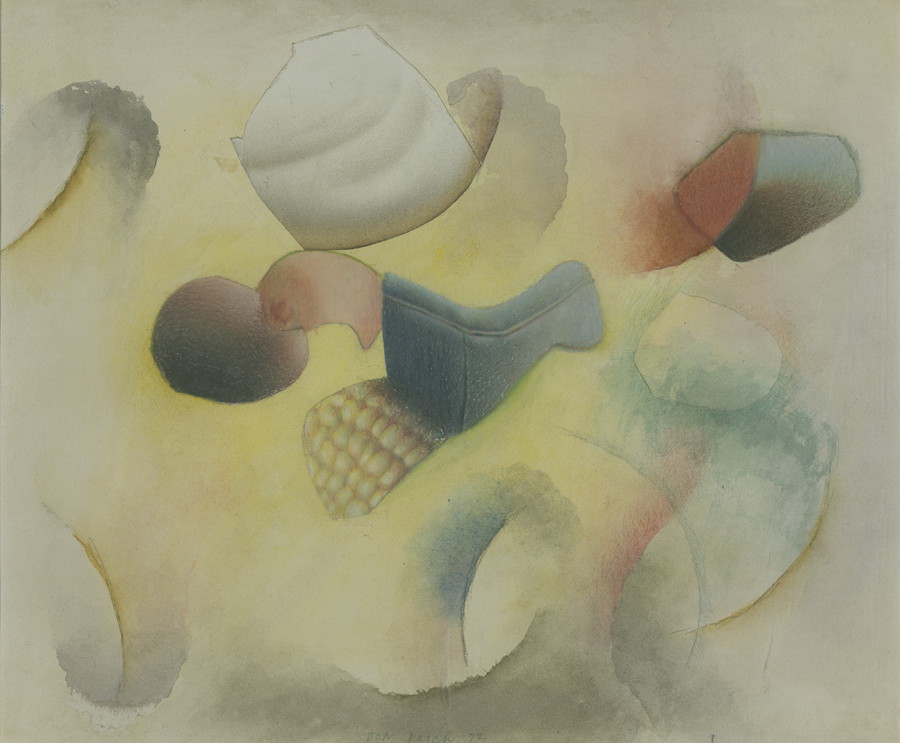
Field, 1972 Drawing with possible collage. Driving down California Highway 99 in a low-lying tule fog, I saw the flat grey form of a distant tree rising out of the mist. Stark, mushroom-shaped.
“It looks like an explosion,” I thought, but then, remembering that I have never seen an explosion, I corrected myself: “It looks like a photograph of an explosion.”
Reich’s art had taught me that distinction.
|
| BACK | 
| NEXT |