
| BACK |
| NEXT |
|
35  In the 1970s there was a move, in Sacramento and elsewhere in the US, to turn away from abstraction, in its death throes with DeKooning, and back to realism.
A slick, ingratiating, ironic, super realism along with Pop Art, funky cartoonism and other approaches. Reich suspected this was simply a bid for sales -- realism is always a people-pleaser.
The art market was hot for it. Andy Warhol, et al.
In Sacramento, Wayne Thiebaud, another of Reich’s teachers, and a friend and mutual fan, was a dominant figure in Pop Art, but there were other Californians who were making big money in New York selling eye candy.
His opening shot at neo-realism aimed his “placement” techniques on a classic Thiebaud poster.
In the 1970s there was a move, in Sacramento and elsewhere in the US, to turn away from abstraction, in its death throes with DeKooning, and back to realism.
A slick, ingratiating, ironic, super realism along with Pop Art, funky cartoonism and other approaches. Reich suspected this was simply a bid for sales -- realism is always a people-pleaser.
The art market was hot for it. Andy Warhol, et al.
In Sacramento, Wayne Thiebaud, another of Reich’s teachers, and a friend and mutual fan, was a dominant figure in Pop Art, but there were other Californians who were making big money in New York selling eye candy.
His opening shot at neo-realism aimed his “placement” techniques on a classic Thiebaud poster.
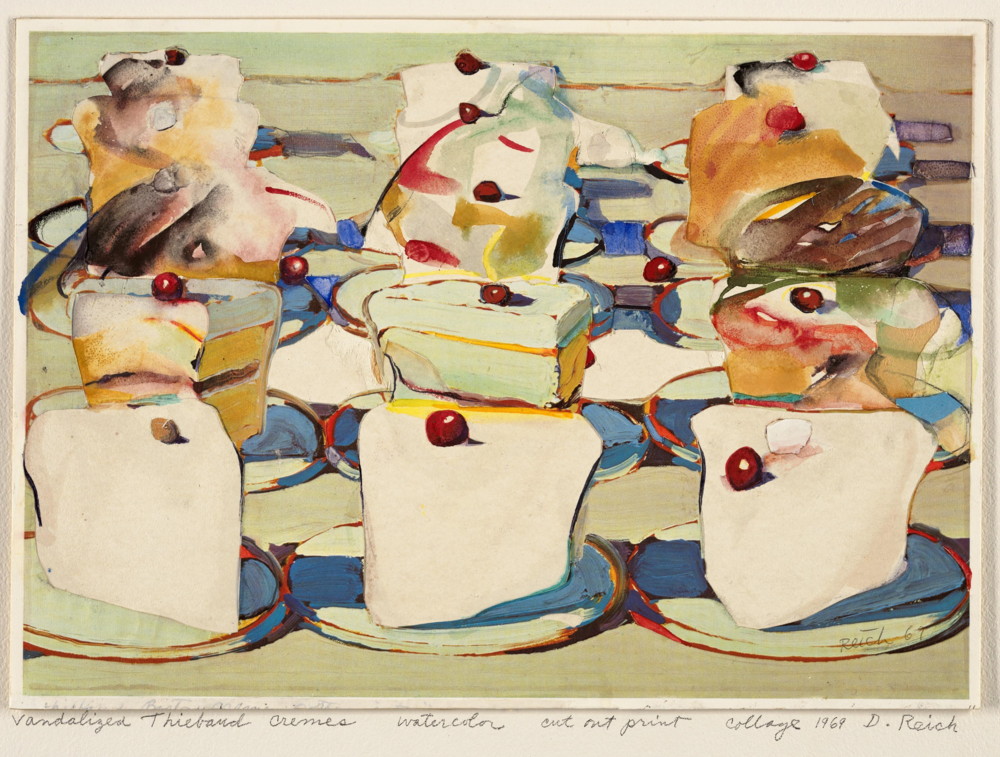
Vandalized Thiebaud Cremes, 1970. Crocker Art Museum, gift of the artist in memory of Marjorie A. Reich |
36
He began making confrontational, not pleasing work. It was the only time in his life when he went for affect, and it was abrupt, disruptive effect, not entertainment, that he was after.
He was reacting against the mode of the day, but what he did was never merely reactive. It was well worked out, laboriously executed for its own sake. He agreed with Gertrude Stein when she said, "Remarks are not literature."
He went back to his experiments in Mexico and began not just using cut-out pieces of his own watercolors, but, in a crucial philosophical move, began mimicking collage. Creating a crypto-pseudo-ironic realism.
He did two pieces in the early 1970s that adumbrated or presaged the work he later said was what he had been aiming for all his life.
|
| BACK |  | NEXT |